By now, we’ve all had our “aha” moment with Generative AI. Whether it was writing a poem or debugging a snippet of code, the ability of Large Language Models (LLMs) to generate text is impressive. But in 2026, the novelty of “chatting” has faded.
The industry has moved toward something far more potent: Agentic AI Systems.
If Generative AI is a brilliant consultant who gives you advice, Agentic AI is the tireless employee who actually goes and does the work.
What Makes an AI “Agentic”?
The term “agentic” refers to agency the capacity to act independently. Unlike traditional AI that waits for a prompt to produce an answer, an agentic system is goal oriented.
Autonomy, Reasoning, and ActionAn agentic system doesn’t just predict the next word; it predicts the next action. When you give an agent a goal for example, “research this competitor and update our pricing strategy” it doesn’t just give you a summary.
It browses the web, identifies key data points, accesses your internal CRM via API, and drafts a new pricing table for your approval.
Generative AI vs. Agentic AI
The difference is fundamental:
Generative AI: Static. It processes an input and provides an output.
Agentic AI: Dynamic. It uses a reasoning loop (like ReAct or Chain-of-Thought) to break a complex goal into smaller sub-tasks, executing them one by one.
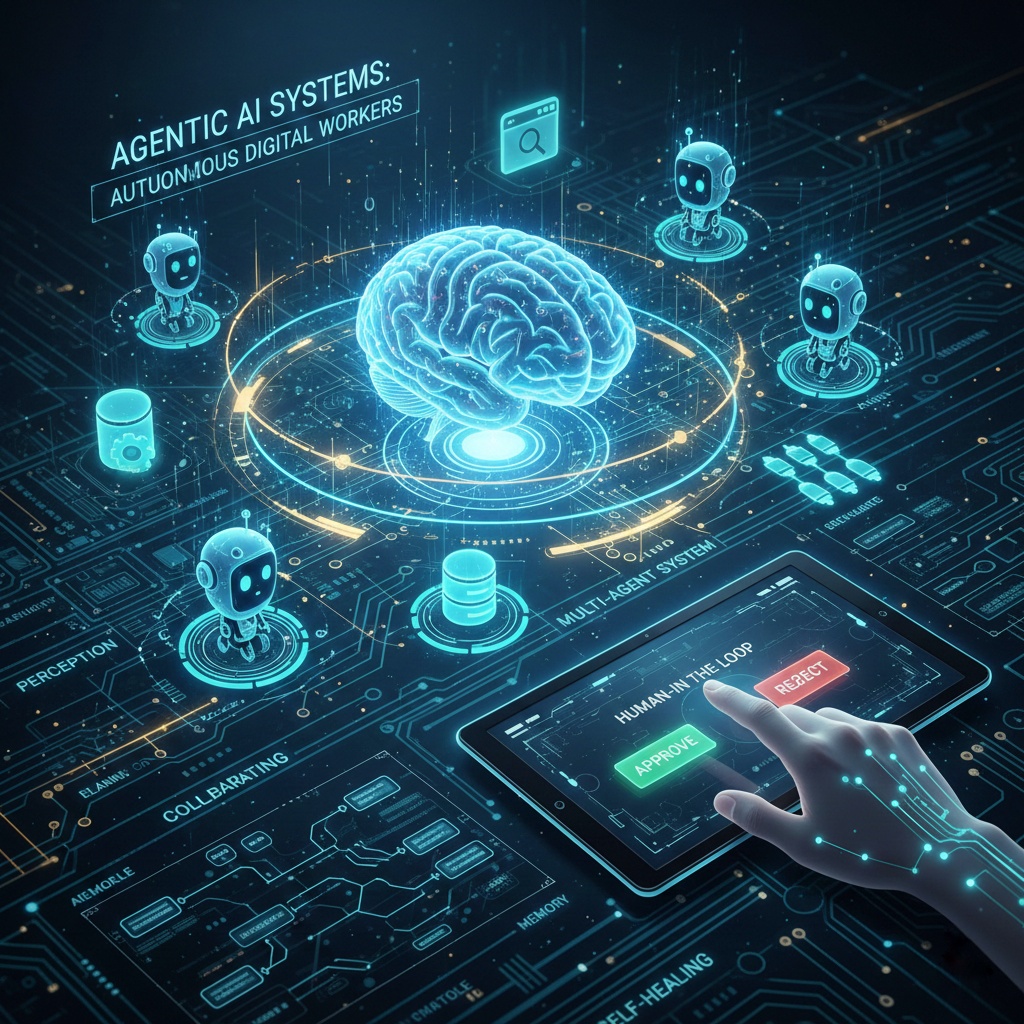
The Core Architecture of Agentic Systems To function without constant hand-holding, these systems rely on a sophisticated cognitive architecture. Think of it as the “brain” of the agent.
Perception & Tool Use: Agents aren’t confined to a chat box. They use “tools” APIs, web browsers, and database connectors to perceive and interact with the world.
Planning: This is where the magic happens. The system uses the LLM to create a roadmap. If a step fails, the agent “reflects” on why and tries a different path.
Memory: Effective agents require Persistent Memory. They need to remember what they did ten steps ago and what they learned from a similar task last month.
Real-World Applications in 2026
We are seeing a massive shift in how global enterprises operate. Agentic systems are no longer “experimental”; they are foundational.
Self-Healing Supply Chains: In 2026, logistics agents are monitoring global shipping delays in real-time. If a storm hits a port in Singapore, the agentic system autonomously negotiates with alternative suppliers and reroutes cargo before a human even sees the alert.
Agent-to-Person (A2P) Engagement: Marketing has evolved. Instead of blast emails, companies use agents that understand a customer’s entire history.
These agents can proactively reach out to solve a potential billing issue or suggest a product update based on actual usage patterns.
Designing for Trust: Governance and Human-in-the-Loop
The biggest hurdle for agentic AI isn’t technology it’s trust. Giving a piece of software the “keys to the house” to make financial decisions or edit live databases is risky.
This is why Human-in-the-Loop (HITL) frameworks are critical. High performing agentic systems are designed with “guardrails.” The agent does the heavy lifting, but it pauses for human confirmation at “high stakes” junctions such as final payment execution or public facing communications.
The Future: Multi-Agent Collaboration (MAS)
The next frontier is not a single “super-agent,” but a team. We are seeing the rise of Multi Agent Systems (MAS), where specialized agents collaborate. One agent might be an expert in data retrieval, another in creative writing, and a third in compliance. They “talk” to each other, peer-review each other’s work, and deliver a polished final product.
Final Thoughts for 2026
The transition to agentic AI systems represents the most significant change in software architecture since the cloud. We are moving away from tools we use toward partners we direct. For businesses, the goal is no longer to “implement AI,” but to build an autonomous workforce that scales with intent.
Expert Tip: If you’re starting your agentic journey today, focus on “Single Responsibility” agents first. Master one workflow like automated invoice reconciliation before trying to build an all knowing digital assistant.


2 thoughts on “Agentic AI Systems: The Shift from Chatbots to Autonomous Digital Workers”