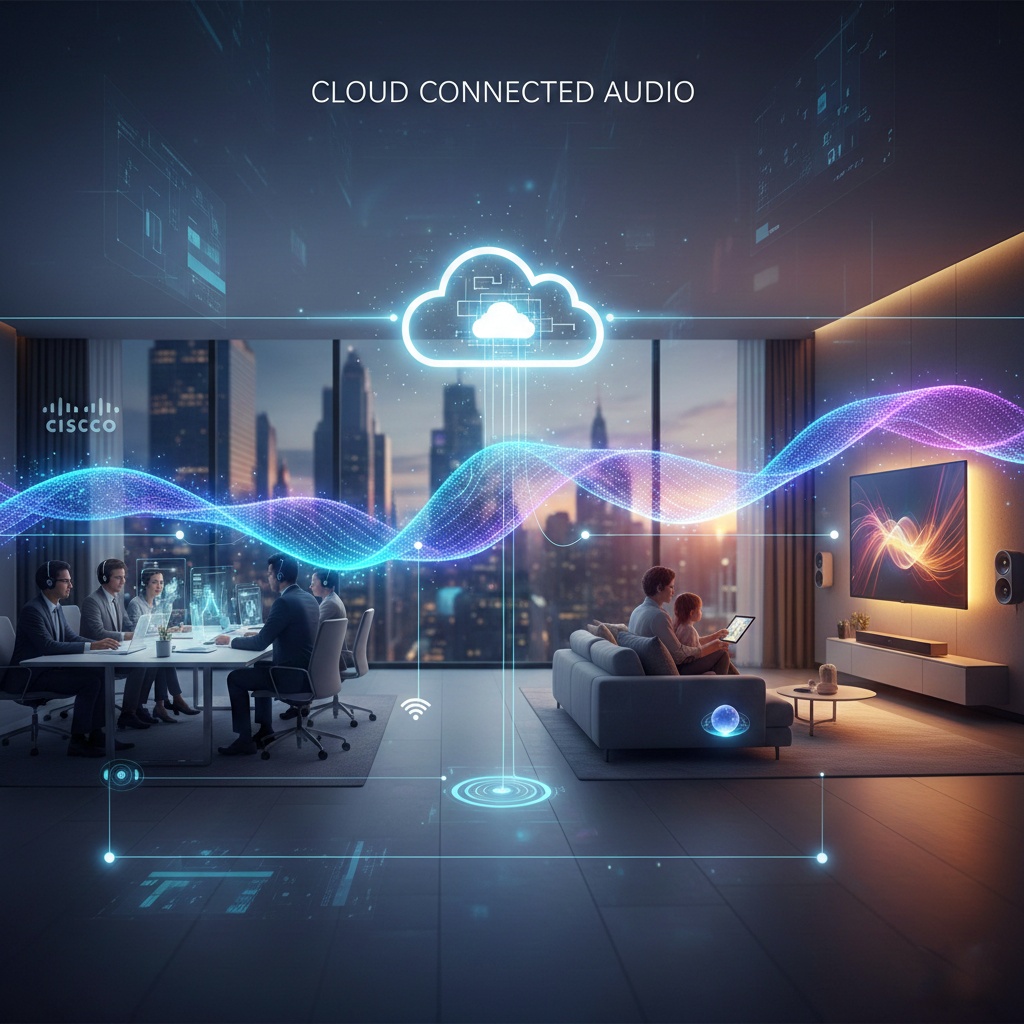
In the rapidly evolving landscape of digital communication and home entertainment, the term “Cloud Connected Audio” has shifted from a niche technical buzzword to the bedrock of how we experience sound. Whether it is a global enterprise synchronizing thousands of meeting participants or a smart home streaming lossless spatial audio to every room, the “cloud” is no longer just a storage space it is the engine of sonic delivery.
But what exactly makes cloud connected audio superior to traditional setups, and why is 2026 the turning point for its global adoption?
What is Cloud Connected Audio?
At its core, Cloud Connected Audio (CCA) is the integration of audio processing, management, and delivery services through cloud based platforms rather than localized hardware. In an enterprise setting, it often refers to services like Cisco Webex Cloud Connected Audio, which bridges on-premise IP telephony with cloud-conferencing software.
In a consumer context, it represents the shift from “wired speakers” to an interconnected ecosystem where audio data is pulled directly from high-speed servers, processed via AI in the cloud, and delivered with surgical precision to wireless end points.
The Shift from Hardware-Centric to Cloud-Native
Traditionally, audio quality was limited by the “pipes” it traveled through copper wires, local servers, or limited Bluetooth bandwidth. CCA removes these bottlenecks.
By leveraging SaaS (Software as a Service) models, audio systems can now receive over-the-air (OTA) updates that improve sound profiles and add features without the user ever touching a screwdriver.
How Cloud Connected Audio Works: The Technical Architecture
The magic of CCA happens in the “handshake” between your local network and the global data center.
1 . Ingestion: Audio is captured and digitized using high-fidelity codecs.
2 . Transmission: Instead of traveling through the standard Public Switched Telephone Network (PSTN), the data is routed via SIP (Session Initiation Protocol) or dedicated cloud interconnects.
3 . Processing: In the cloud, the audio undergoes Digital Signal Processing (DSP). This includes AI-driven noise cancellation, leveling, and even real-time translation.
4 . Delivery: The “cleaned” audio is streamed back to the end-user with ultra-low latency, often under 50ms, making it indistinguishable from local sound.
Key Benefits for Enterprises: Why Business is Moving to the Cloud
For the modern CIO, cloud connected audio isn’t just about “better sound”; it’s about the bottom line and operational agility.
Cost Reduction through Eliminated Legacy Hardware
The days of maintaining massive, expensive on-site PBX (Private Branch Exchange) systems are fading. By moving to a cloud-connected model, businesses eliminate the capital expenditure (CapEx) of hardware and the high maintenance costs of specialized IT staff. You pay for what you use, often on a per-user basis.
Scalability and Global Reach
In a hybrid work era, a team member in London needs the same audio quality as one in New York. CCA providers use Global Edge Networks to ensure that audio traffic is routed to the nearest data center, minimizing lag and “jitter” during critical board meetings.
The Home Revolution: Multi-Room Sound and High-Fidelity
While businesses focus on efficiency, consumers are focused on Experience. Cloud-connected audio has birthed the “Seamless Home.”
Seamless Control and IoT Integration
Modern systems like Sonos, Control4, and Apple AirPlay 2 represent the consumer face of CCA. By connecting directly to streaming services via Wi-Fi rather than relying on a phone’s Bluetooth, these speakers maintain a constant connection to the cloud. This allows for:
. Uninterrupted Streaming:
Your music doesn’t stop when your phone rings.
. Multi-Zone Sync:
Play “Jazz” in the kitchen and “Classical” in the study, all controlled from a single interface.
Critical Trends in 2026: AI, Low Latency, and Spatial Formats
As we move through 2026, several key technologies are pushing the boundaries of what cloud audio can do:
AI-Native Enhancement: Cloud servers now use machine learning to “fill in” data gaps caused by weak Wi-Fi, preventing audio drops before they happen.
Open Spatial Formats: New standards like Eclipsa Audio (the Google/Samsung collaboration) are allowing cloud-connected devices to stream 3D “Atmos-like” sound without proprietary hardware locks.
Sustainable Streaming: Providers are optimizing bitrates to reduce the energy consumption of data centers, making high-res audio more eco-friendly.
Choosing the Right Cloud Audio Provider
When selecting a system, whether for a home or a 500-person office, consider the following “Big Three” factors:
1 . Interoperability: Does the system play well with others? (e.g., Does your Webex audio integrate with your existing Cisco IP phones?)
2 . Security: Ensure the provider uses end-to-end encryption. In 2026, “Audio Sniffing” is a legitimate cybersecurity threat.
3 . Bandwidth Management: A good CCA provider will have “Adaptive Bitrate” technology to ensure your audio stays clear even if your internet speed dips.
Conclusion: Why Connectivity is the New Standard
Cloud connected audio has successfully moved sound from a physical commodity to a dynamic service. It offers a level of flexibility, quality, and cost-effectiveness that local hardware simply cannot match. As AI continues to integrate into the cloud layer, the “connected” part of audio will soon become invisible leaving us with nothing but pure, perfect sound.


2 thoughts on “Cloud Connected Audio: The 2026 Guide to the Future of Sound”